
Helium-3
A path to large quantities of polarized helium-3
Three changes to the glass cell open a path to spin-exchange optical pumping of much larger quantities of gas.
Why helium is harder
Helium-3 is polarized by the same spin-exchange optical pumping as xenon. However, the process is thousands of times slower. A cell of helium takes hours to polarize. During those hours, relaxation at the cell wall must remain slow. Only certain aluminosilicate glasses meet this requirement.
To polarize more gas, researchers raised the pressure. High pressure requires thick, curved glass. Thick glass absorbs some of the laser light, and its birefringence alters the circular polarization of the light. It also conducts heat poorly, so the heat from kilowatts of laser light cannot escape. Hot spots form near the droplets of alkali metal. More metal evaporates there, and the denser vapor absorbs more light. The heating then accelerates. This is called thermal runaway. The thick-walled spherical cell had reached its limit.
Three changes
1. The cell goes inside a pressure vessel. The steel vessel holds the pressure. The pressure is the same on both sides of the glass, so the glass is not stressed. The cell can therefore be much larger. The cell we operate holds about two liters. The cell is a cylinder, so it can be made longer. The pressure vessel is designed to accommodate cells up to 8 liters. The steel vessel also serves as the return path for the magnetic field.
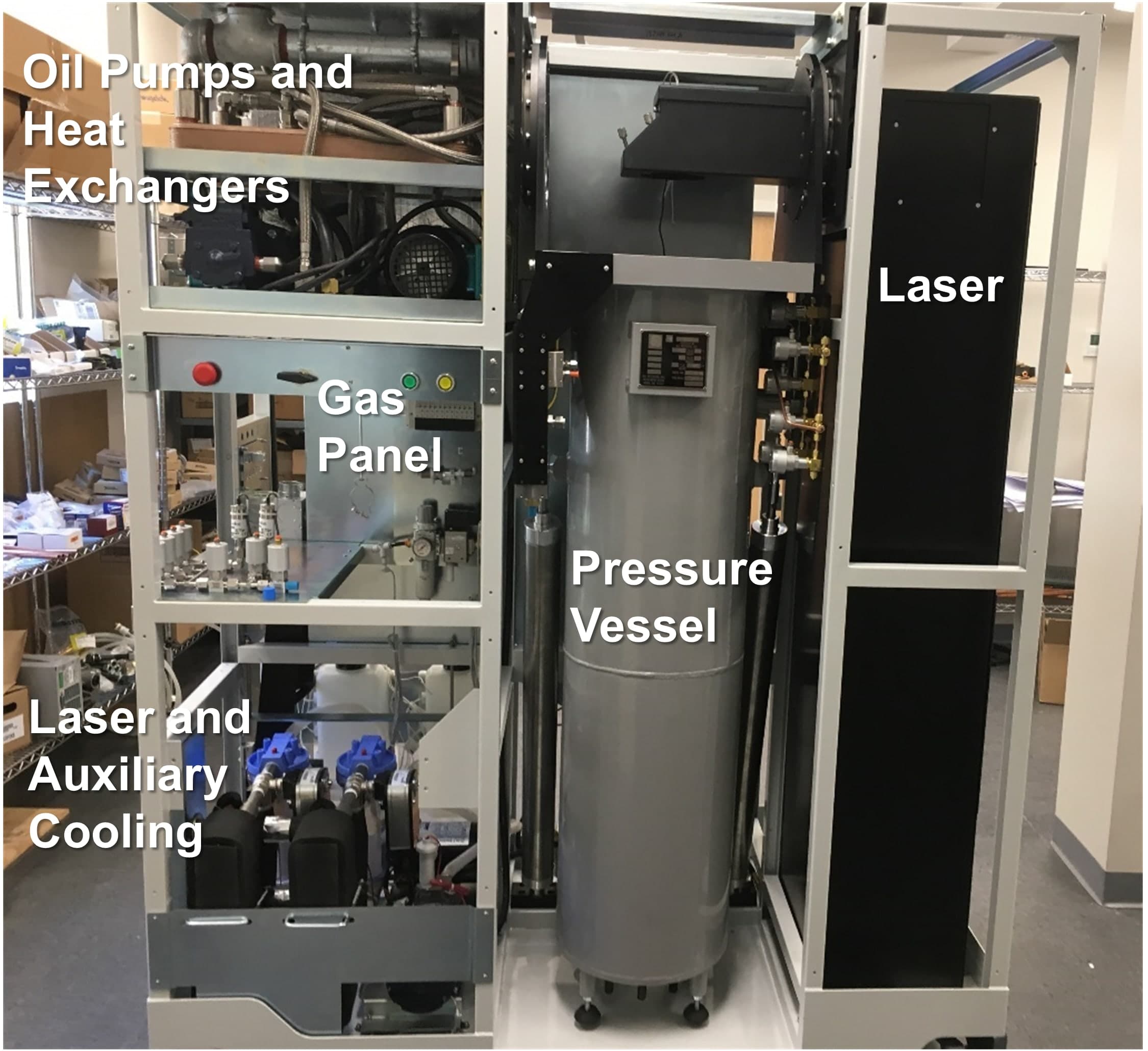
2. The wall is as thin as practical. The pumping laser deposits heat in the gas, so the gas settles at a temperature above that of its surroundings. Good thermal contact keeps that difference small. Poor thermal contact can lead to thermal runaway. Heat passes easily through a thin wall. Wall relaxation is slow only on glass. Because the glass no longer holds the pressure, the glass wall can be as thin as practical.
The shape of the cell follows the same reasoning. Nuclear polarization relaxes at the wall, so earlier cells were shaped to minimize the surface-to-volume ratio. A sphere has the lowest ratio. Today the glass types and the surface preparations that preserve polarization are well known. The relaxation time can therefore be balanced against heat transfer. Our cell is a long cylinder. It has a higher surface-to-volume ratio than a sphere, and that surface removes heat. The cylinder also matches the shape of the laser beam. The beam is collimated and aligned with the magnetic field. This alignment maximizes the spin polarization. The thin-walled cell is in close contact with an aluminum shell. Circulating fluid cools the shell, and electric heaters warm it. The alkali metal stays at a stable temperature, even while the cell absorbs kilowatts of laser light.
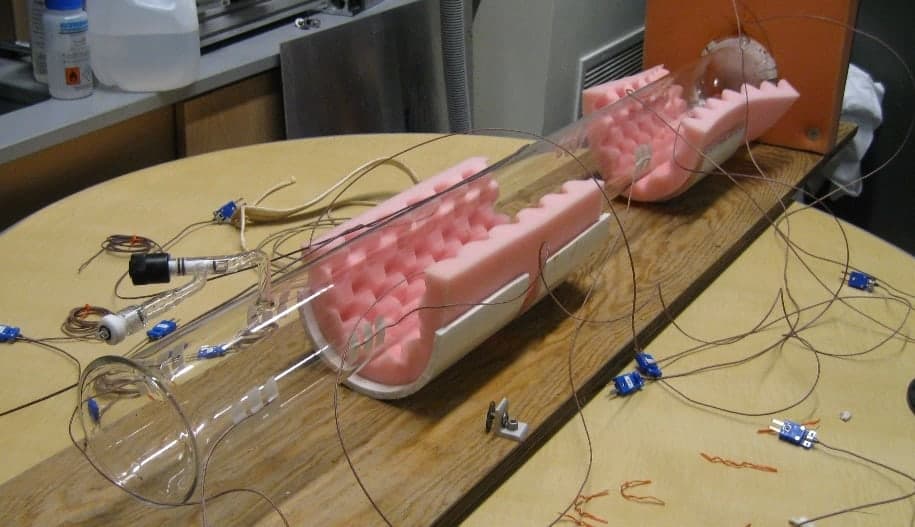
3. The cell is tilted. In a vertical cell, hot gas rich in rubidium vapor rises and collects at the top. The laser enters at the top. The vapor cloud becomes opaque and absorbs the light at the window. The cloud then heats further. Tilting the cell breaks the vertical symmetry. The gas heated by the laser rises along one side of the cell. It cools near the top and sinks along the other side. Gravity drives this circulation continuously. The circulation carries the opaque cloud away from the window.
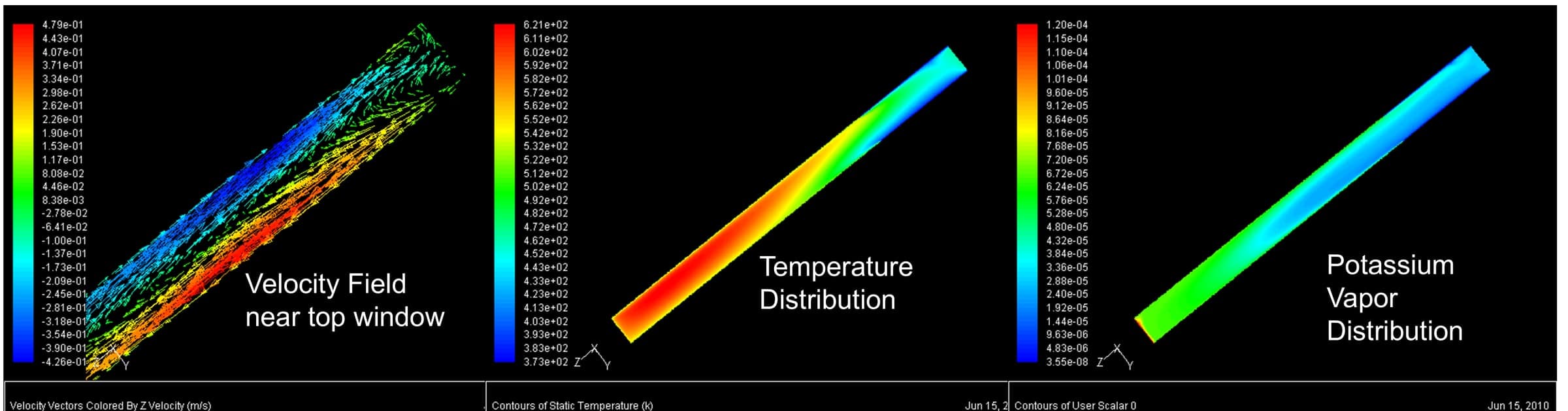
The light comes from our own kilowatt-scale diode lasers. Their spectrum is narrowed to match the absorption line of the alkali at the operating pressure. The cells contain a potassium-rubidium mixture for hybrid spin-exchange optical pumping. Potassium transfers polarization to helium-3 more efficiently than rubidium.
What it delivers
- Around 85%
- helium-3 polarization, in a two-liter cell
- About 5 hours
- spin-up time of the best run
- Up to 70 hours
- longitudinal relaxation time (T1) of a two-liter cell
The polarizer has completed more than fifty runs at high laser power with the two-liter cell. Each cell has a valve. The polarized gas can be withdrawn, and the cell can be refilled.
Published results
The results are reported in S. J. Anderson et al., “A path to scaling helium-3 spin-exchange optical pumping,” Journal of Applied Physics 127, 223103 (2020).
The cell was a two-liter aluminosilicate cylinder in a steel pressure vessel. It held a mixture of helium-3 and nitrogen at about 2 bar at room temperature. Most runs used 300 W of spectrally narrowed laser light. The cell wall was held near 235 °C.
The best run reached a polarization of 85.6% in the cell. The spin-up time was 5.4 hours. We measured the gas in an external NMR polarimeter and found a polarization of 80.3% with an uncertainty of 7.3%. We extrapolated that value back to the cell, correcting for relaxation during transfer. The error bar is large, so we say “around 85%.”
The relaxation time (T1) stayed between 35 and 55 hours over more than fifty runs. A record of 70 hours was measured with this cell in a test station. T1 changed with the direction of the magnetic field. It was lowest for the field direction used during pumping.
A long T1 depends on the whole instrumented environment around the cell. Magnetic field uniformity, the materials near the cell, and the cleanliness of the gas path all affect relaxation. Each must be controlled at once, while the cell absorbs hundreds of watts of laser light. This is why the result is not simple to repeat.
Read the paper: Journal of Applied Physics (DOI) · Public full text (OSTI) · All publications
Other methods
Spin-exchange optical pumping is usually done in a sealed, high-pressure glass cell of about 300 cc.
Helium-3 can also be polarized by metastability-exchange optical pumping. That method polarizes the gas in about one second, at about a thousandth of an atmosphere. It reaches high polarization at that low pressure. A special compressor then raises the pressure without destroying the polarization. The method is mature, and it delivers large quantities. It supplies neutron laboratories and lung-imaging networks today.
Our polarizer is one of the few open, valved systems that reach high polarization by spin-exchange optical pumping. It polarizes the gas directly at the operating pressure and needs no compressor. The goal of our program is to produce comparable quantities with this method.
What it is for
We have built and delivered a helium-3 polarizer of this design, and we are now installing it. Polarized helium-3 has several uses.
Fusion energy research. Theory predicts that some fusion reactions proceed faster when the spins of the fuel nuclei are aligned. Polarized helium-3 is one of the fuels that can test this.
Neutron beams. Polarized helium-3 absorbs neutrons of one spin state and transmits neutrons of the other. A cell of polarized helium-3 can polarize a neutron beam or analyze its polarization. It works over a wide range of neutron energies and angles. This makes it well suited to spallation neutron sources.
Polarized targets. In polarized helium-3, almost all of the nuclear spin comes from its single neutron. Accelerator laboratories therefore use it as a polarized neutron target. Experiments scatter high-energy electrons from these targets. They study the spatial distributions and motions of quarks inside the nucleons that make up the nucleus. Because our cells are valved, polarized gas can be circulated through a target, cooled and pressurized, and returned to the polarizer. A target fed this way holds more polarized gas, so an experiment can collect data faster.
Lung imaging. Much of the early research on lung imaging with hyperpolarized gas used helium-3. The supply of helium-3 is small and fixed. Clinical imaging has therefore moved to xenon-129. Helium-3 remains valuable in research.
We sell helium-3 polarizers. We do not sell helium-3 gas. To discuss a polarizer, please use the contact form.